
Fifteen years ago, moving from on premises data centers to the cloud looked risky to a lot of executives. Today it looks like one of the best decisions a company could have made, and the companies that made it early still have the advantage.
The early movers did not treat the cloud as a new place to rent servers. They went cloud first. They made it the default for how the business built and ran its technology, and they redesigned their systems to take full advantage of it. That gave them speed, scale and the ability to launch things their competitors could not.
AI is the next shift of that size, and it calls for the same kind of commitment. The trouble is that many companies are mistaking a purchase for a strategy. They buy licenses for an AI assistant, hand them out to employees and hope productivity follows. This article makes the case for the approach that worked with the cloud: putting AI to work in the back of the business, doing the work itself, and building the company around it. That is what going AI first actually means.
What the cloud leaders got right
The move from on premises infrastructure to the cloud is the best guide we have to what comes next, because most of today's executives lived through it.
In August 2008, a database corruption stopped Netflix from shipping DVDs for three days. The company decided to move to Amazon's cloud, and it went all in. Rather than copying its data center across, it rebuilt virtually all of its technology as hundreds of small services designed for the cloud. By January 2016 it had shut down its last data center components for streaming. It had eight times as many streaming members as in 2008, viewing had grown a thousandfold, and that same month it launched in more than 130 new countries. Netflix says its cost per streaming start fell to a fraction of what it was in the data center.
Capital One made the same commitment in a far more regulated industry. It started its move in 2012, became the first US bank to announce it was going all in on the cloud, and exited eight data centers. Roughly 80% of its nearly 2,000 cloud applications were built from the ground up for the cloud. The bank reports that setting up a development environment went from three months to minutes.
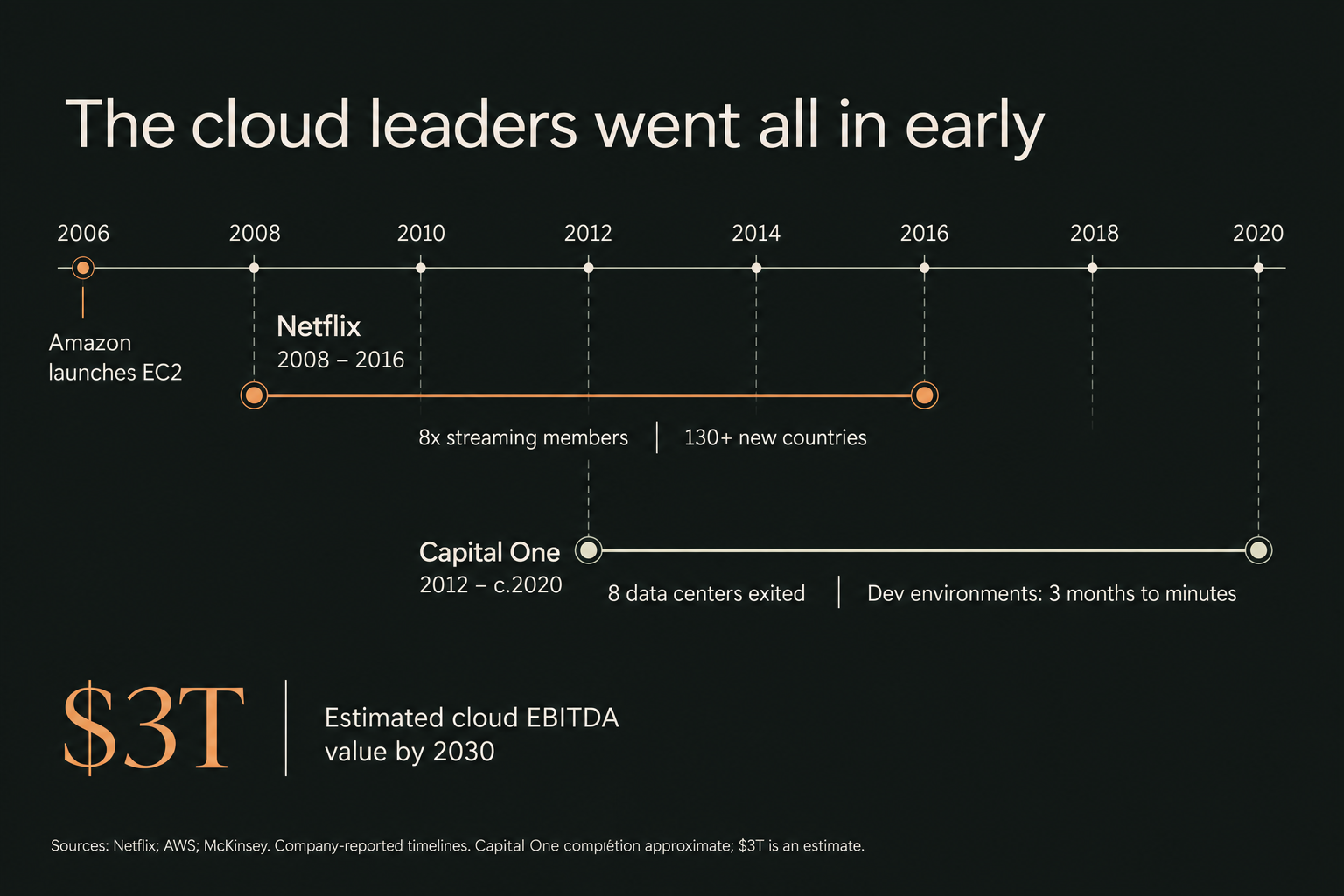
The size of the prize was enormous. McKinsey estimates that cloud could generate about $3 trillion in EBITDA value for the world's largest companies by 2030. Its research also found that the value from using the cloud to build new products and serve customers in new ways is worth more than five times what cutting IT costs alone delivers. The biggest winners were the companies that used the cloud to change how the business worked, not just where its servers sat.
Notice what cloud first never meant. It never meant giving every employee a file sharing account and calling the company a cloud business. Those tools were useful, but the advantage came from moving the systems that actually ran the business.
Cloud first meant running the business on the cloud. AI first should mean running the business on AI.
Economists Erik Brynjolfsson, Daniel Rock and Chad Syverson describe how these shifts pay off as a productivity J-curve. Technologies like the cloud and now AI need investments that never show up on a balance sheet: redesigned processes, new skills, new ways of organizing. Productivity can look flat while that investment is made, then rises sharply once it is in place. The difference with AI is speed. The cloud leaders had the better part of a decade to pull ahead. With AI getting better and cheaper every few months, the next set of leaders will pull ahead much faster.
Seats are not a strategy
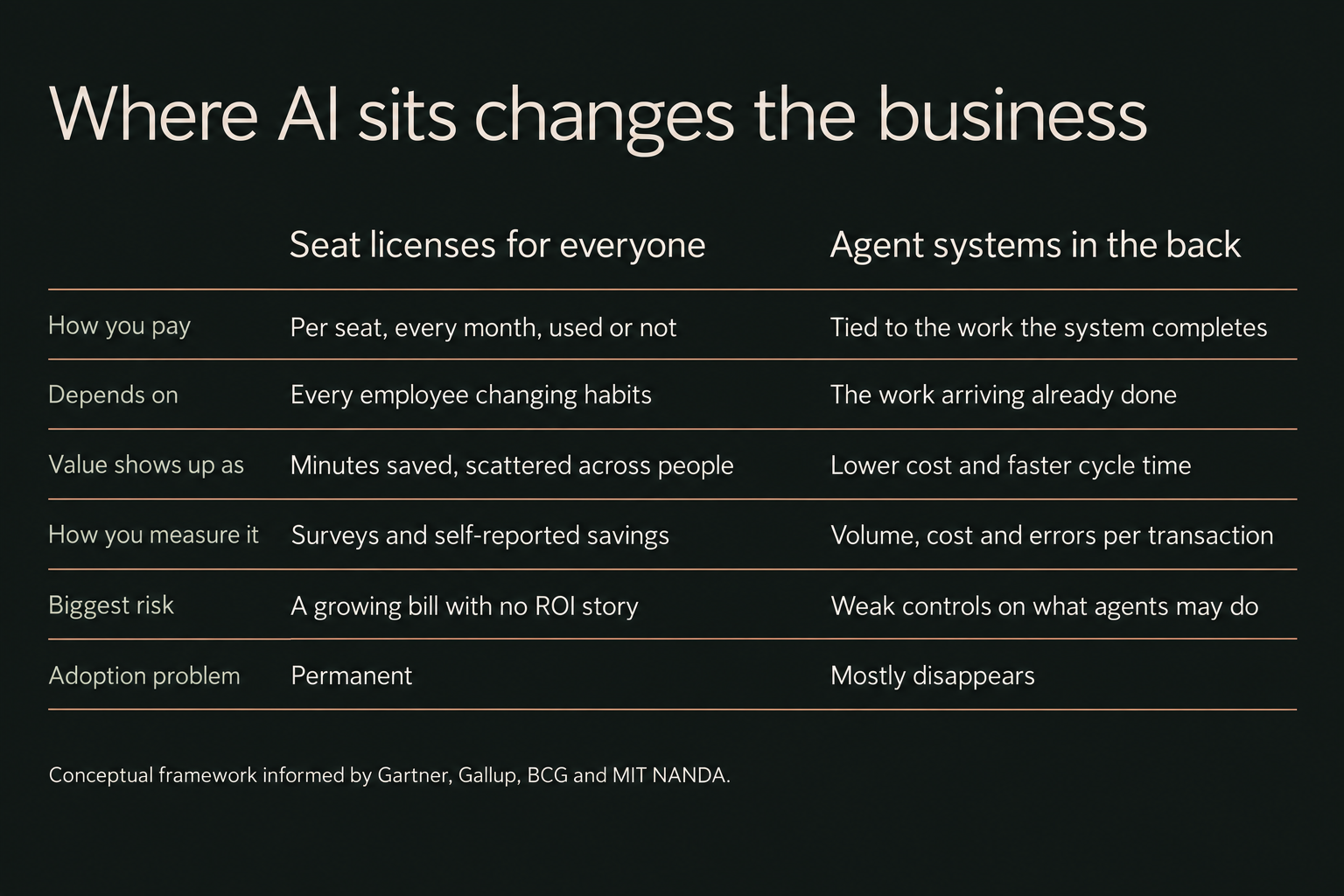
The AI version of the file sharing account is the seat license. A company signs an enterprise agreement for an AI assistant, gives everyone a login, runs some training and waits for the productivity to appear.
It is easy to see why this is popular. It is fast, it looks like progress, and nobody has to redesign anything. Almost every company now uses AI somewhere: Stanford's 2026 AI Index reports that 88% of surveyed organizations used AI in 2025. But access is not adoption, and adoption is not results.
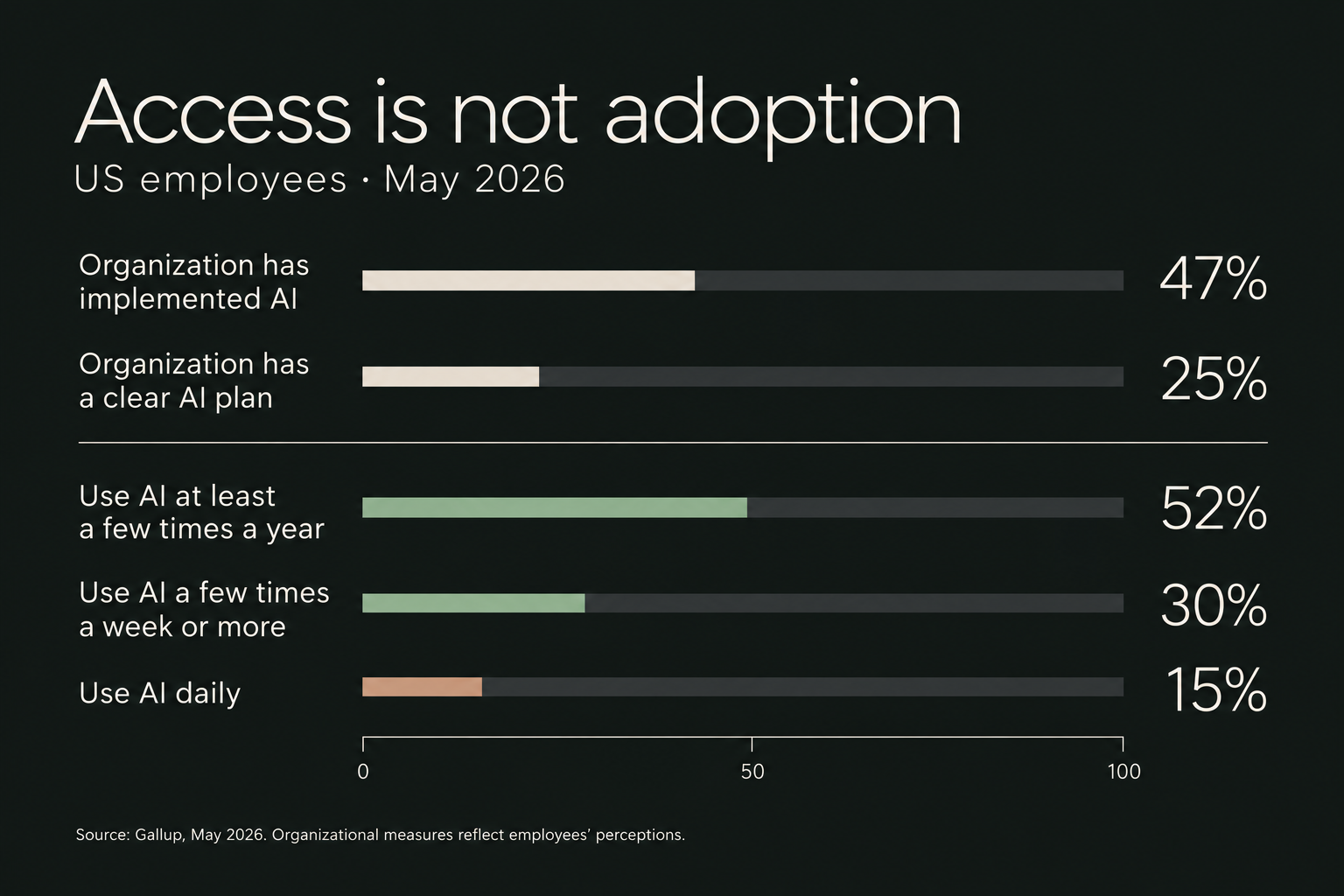
Gallup's May 2026 survey found that 47% of US employees say their organization has implemented AI, but only 15% use it daily and only 25% say their employer has communicated a clear plan for it. BCG's 2025 AI at Work survey of more than 10,000 workers found regular AI use among frontline employees stuck at 51%, even as more than three quarters of managers use it several times a week.
The licenses that do get used rarely produce a number a CFO can defend. In Gartner's 2025 Microsoft 365 and Copilot survey of IT leaders, 40% said their organizations were piloting Microsoft 365 Copilot, but of those that had finished pilots, only 5% were moving to a larger deployment, and Gartner said impact, value and ROI measurements remained elusive.
The deeper problem is where the value goes. A large study of Danish workers in AI-exposed jobs by economists Anders Humlum and Emilie Vestergaard found that chatbots saved people about 3% of their working time on average, with no measurable effect on earnings or hours worked. Saved minutes are real, but they are scattered across hundreds of people. Unless someone redesigns the work, those minutes get absorbed into email, meetings and slightly longer lunches. They never show up as a line on the P&L.
The seat math
A company with 2,000 employees that buys a $30 per user, per month AI add-on for everyone commits about $720,000 a year in new operating expense, before any increase in base license prices. The value it is buying is diffuse, self-reported and almost impossible to tie to revenue or cost.
None of this means employees should not have good AI tools. They should. But a tool rollout is an IT decision, not an AI strategy. McKinsey's 2025 survey found that only about 6% of organizations are high performers that attribute 5% or more of EBIT to AI, and that those companies were nearly three times as likely as others to have fundamentally redesigned their workflows. The difference is not who has more licenses. It is who changed how the work gets done.
Put AI in the back
The seat model puts AI at the front of the company, in every employee's hands, and makes success depend on thousands of people changing their habits. That turns adoption into a permanent problem: training programs, champions networks, usage dashboards and quarterly pushes to get the numbers up.
There is a simpler design. Put AI in the back, inside the processes that run the business, and let it do the work.
In practice, that means an invoice arrives and an agent system reads it, matches it to the purchase order and the receipt, checks it against the contract, posts it and schedules the payment. A new customer signs, and the system sets up the accounts, collects the documents, checks them and opens the right tickets. Nobody has to remember to open an assistant and type a prompt. The work simply arrives done, and people see only the exceptions, each one with the context they need to decide.
That design removes the adoption problem rather than trying to solve it. Employees do not need to change how they work for the system to deliver value. They need to handle the cases that genuinely need a person, which is usually the part of the job they wanted to be doing anyway.
It also makes ROI measurable. A back office system has a natural unit of work: an invoice, a claim, an order, an onboarding. You can count how many it handled, what each one cost, how long it took and how often it was wrong, then compare those numbers with the baseline. That is a business case a CFO can audit, not a survey asking people how much time they think they saved.
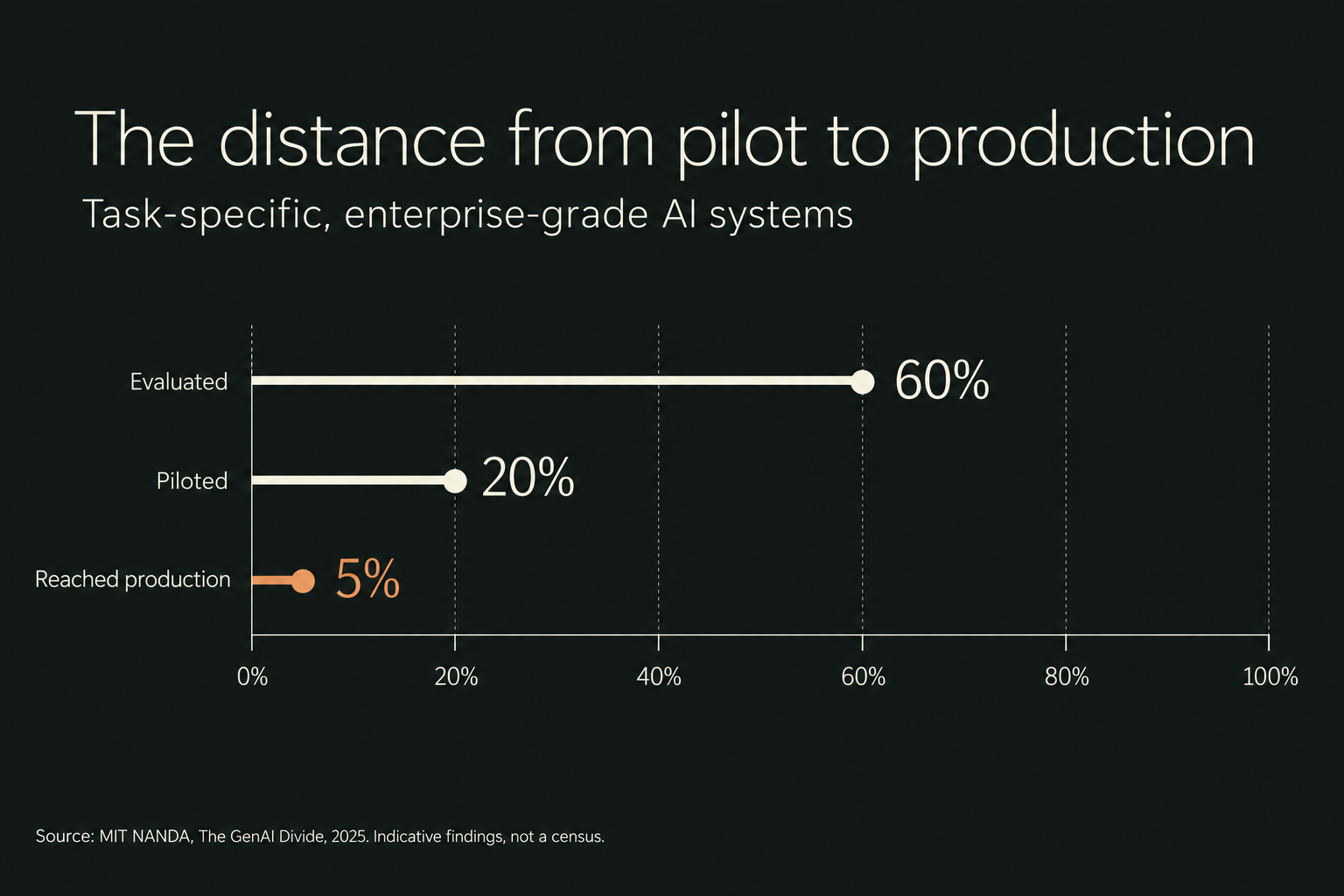
The research points the same way. MIT's Project NANDA, in its 2025 report The GenAI Divide, found that among organizations looking at task-specific, enterprise-grade AI systems, 60% evaluated them, 20% reached a pilot and just 5% made it to production. Its main explanation was a learning gap: most tools do not retain feedback, adapt to context or improve over time. The researchers also reported that back office automation often produced the clearest returns, even though most AI budgets went to sales and marketing.
Back office AI is also where the controls belong. An agent system that runs inside a defined process can have clear permissions, a full audit trail, limits on what it may approve and a named owner who can stop it. That is much easier to govern than thousands of people pasting company data into a chat window.
What rebuilding actually means
Putting AI in the back is the first move. Rebuilding is what happens when you follow that logic across the company. It starts with a different question. Instead of "where can AI help our people?", ask "if we were starting this company today, with software that can read, reason, write and take action, how would we organize it?"
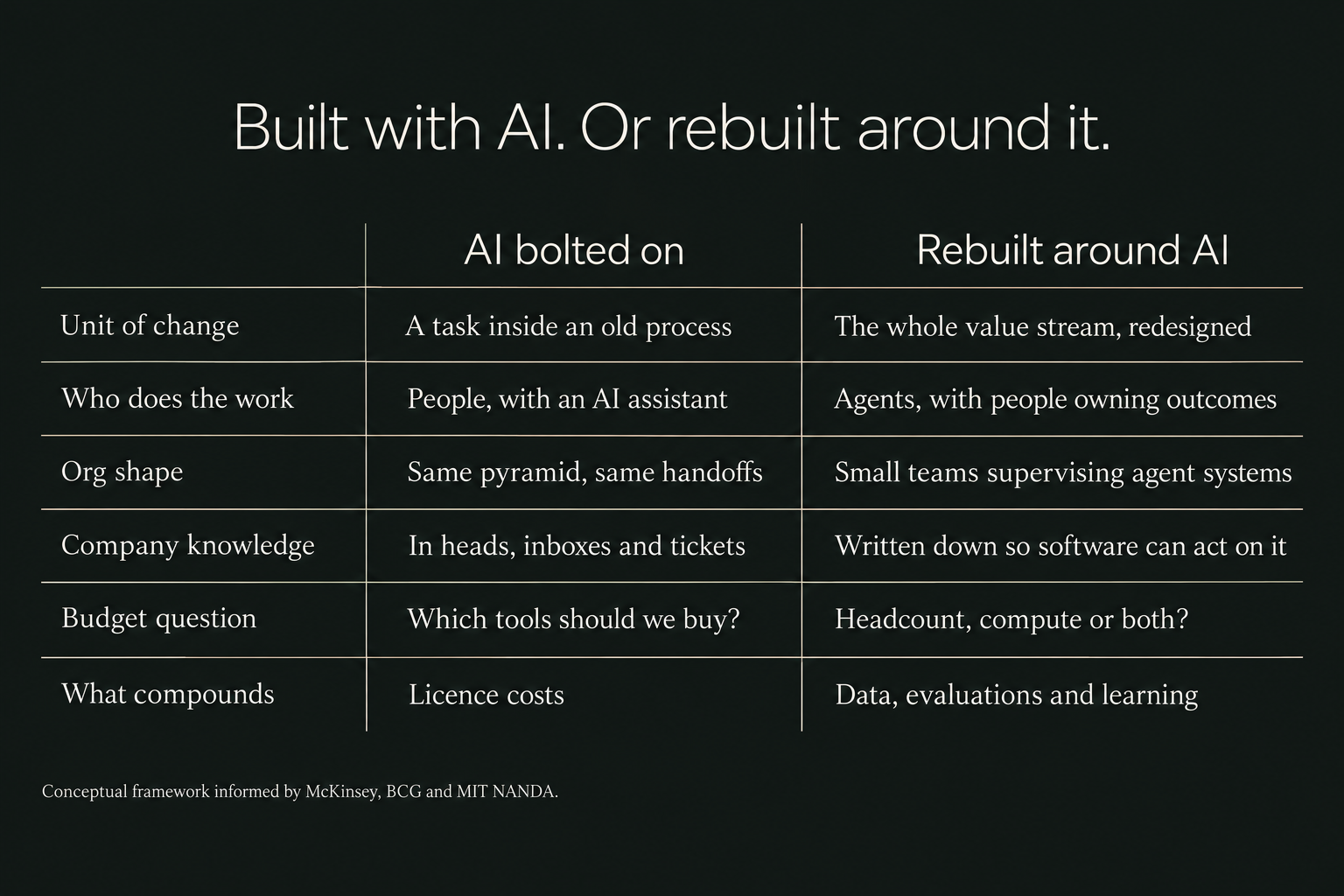
Redesign value streams, not tasks. A task is "draft the reply." A value stream is the whole path from a customer's order to cash in the bank, or from a claim being filed to it being paid. Speeding up one task inside a slow value stream rarely changes the outcome, because the delays live in the handoffs between steps. Rebuild the whole path so agents carry the work from start to finish, and people step in where judgment, accountability or relationships genuinely matter.
Make agents the default workers and people the owners. Microsoft's 2025 Work Trend Index describes what it calls the Frontier Firm, where every employee becomes an "agent boss" and leaders manage a new metric: the ratio of humans to agents in each part of the business. In a rebuilt company, each process has a named person accountable for its outcome. That person sets the rules, handles the exceptions and keeps improving the system.
Write the company down. Agents can only act on what is explicit. Most companies run on knowledge that lives in people's heads, old email threads and ticket histories. Turning that into documented policies, clean data, connected tools and tests built from real past cases is the unglamorous core of the rebuild. It is the kind of intangible investment the J-curve describes, and it is the part competitors cannot copy by buying the same model.
Redraw the org chart. In 1937 the economist Ronald Coase argued that firms exist because coordinating work through the market costs more than coordinating it internally. AI drives down the cost of gathering information, coordinating handoffs and checking work, which means the right size and shape of a company is changing too. Layers that existed mainly to route information and supervise routine work deserve a hard look.
That has consequences for people, and leaders should face them directly. Stanford researchers found that employment for 22 to 25 year olds in the most AI-exposed occupations fell 16% relative to less exposed jobs after late 2022, with the declines concentrated where AI automates work rather than augments it. If software now does the entry-level tasks that used to train junior staff, a rebuilt company has to design a new path for people to build judgment, or it will run out of the experienced people it needs to own its systems.
Change the budget conversation. In April 2025, Shopify CEO Tobi Lütke told employees that before asking for more headcount or resources, teams must show why they cannot get what they need done using AI. You do not have to copy that policy to learn from it. In an AI-first company, headcount and compute are planned together, and AI spending is tied to the work it completes rather than the number of people who have a login.
The gap compounds
The companies that rebuild early are already pulling away. BCG's 2025 survey of 1,250 companies found that only 5% were "future-built" and getting value from AI at scale, while 60% were getting little or none. Compared with those laggards, the future-built group reported 1.7 times the revenue growth, 3.6 times the three-year shareholder return and 1.6 times the EBIT margin.

BCG also found that these leaders plan to spend more than twice as much on AI as laggards, and that agents already account for 17% of the value companies get from AI, expected to reach 29% by 2028.
The gap compounds for a structural reason. A process rebuilt around AI produces a record of every decision, every exception and every correction. Those records become tests, training material and evidence for giving the system more responsibility. Each time a better model arrives, it drops into a structure designed to use it, so capability gains flow straight into the business.
A company that handed out licenses has to wait for every employee to discover what the new model can do. It gets a slightly faster version of the old company. The rebuilt company gets a new one each time the technology improves.
This is the real meaning of preparing for superintelligence. It will not arrive as a single event you can schedule around. It will arrive as a steady series of upgrades, each more capable than the last. The companies built to absorb those upgrades will capture them, just as the companies that went cloud first captured what came after it.
Where to begin
Rebuilding a whole company at once is not realistic. Buying more seats while you wait for certainty is not a substitute. The practical path is to fully rebuild one value stream that matters, prove the numbers, and use it as the blueprint for the rest of the business.
A rebuild, not a rollout
- Audit what you already pay for. List every AI license and subscription, who uses it and what measurable result it has produced. Keep what earns its place and stop treating the rest as strategy.
- Choose a value stream that moves the P&L. Quote to cash, invoice processing, claims, customer onboarding, procurement. Give it an executive owner with the authority to change how it works.
- Redesign it from a blank page. Assume agents do the work in the back. List the points where human judgment, accountability or relationships are genuinely required, and design everything else for software.
- Write the business down and build the controls in. Document policies, decision rights and edge cases. Set permissions, audit trails, escalation paths and a clear way to stop the system. Expand what agents may do only as their performance earns it.
- Measure per unit of work. Track volume, cycle time, cost per transaction and error rates against a baseline taken before the rebuild.
- Reinvest and repeat. Move the capacity you free up toward growth, update hiring and budget rules, then apply the blueprint to the next value stream.
The companies that won the cloud era committed early and rebuilt how they worked around it. AI will reward the same commitment, only faster.
The question for leadership today is not whether your people have access to AI. Most already do. The question is whether AI is doing the work of your business, and whether you are willing to redesign the company it runs through.